
· By Angela Seto
Does snow make our honey white?
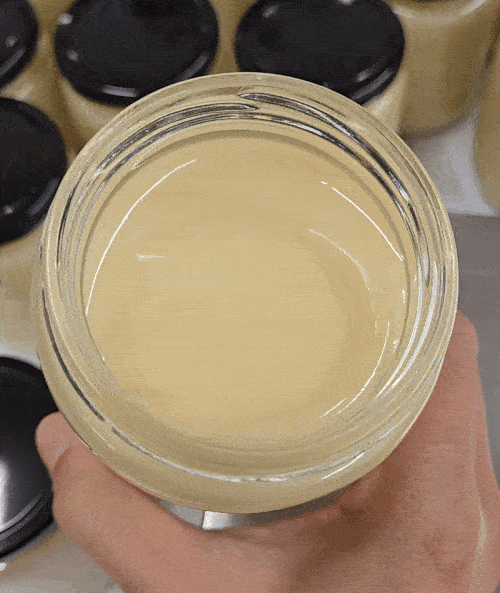
A freshly packed bottle of our white honey, before it has fully set in the jar!
What's new on the farm:
When you think of winter in Canada, Saskatoon pretty much fits the stereotypical image.
Freezing cold, blue skies, and lots of snow.
Of course, the amount of snow varies from year to year. As beekeepers, we always want more, more, more.
That's because the more snow we get over winter, the more water is stored in the ground.
And the sloughs, and the ditches.
Keeping moisture in these areas affects the weather. This effect feeds spring rainstorms, which keep the ground even wetter.
All this moisture in the ground matters. It matters as much as the water that comes from the sky in the spring and summer.
Why? Because plants that get more water produce more nectar.
And more nectar means more honey that the bees can make.
Some plants need a lot of moisture to do well. Other plants survive better in drier climates.
(As an extreme example, this is why the plants in rainforests are completely different than plants in deserts).
For those who have tried our honey, you'll be familiar with its white, thick texture. It's very different from liquid golden honey that you usually see in the store.
This is because the color and texture of honey depends on the flowers that the honeybees collected nectar from, which they turn into honey.
That means that honey should look and taste different all over the world, because flowers all over the world are different.
In Saskatchewan, where we farm, the plants that do well with more moisture are the ones that also make whiter honey.
These are crops like alfalfa, and wildflowers like yellow and white sweet clover (which is different from regular clover).
In honey classification terms, we can produce a honey that is so white, it gets called "water white."
The plants that do better here when it's drier make a darker honey. These are ones like goldenrod and aster.
Frankly, in our case, dark is a relative term, as we never get honey as dark as Manuka honey (from New Zealand) or Buckwheat honey (from Manitoba).
In fact, our "darker" honey is still extremely light compared to those ones. But, it's still a noticeable difference from our water white honey.
If we were a company with different goals, we would do what we could to erase those differences.
Most of the time, commercial honey is treated like a commodity. Make as much as you can, sell as much as you can.
Big producers and processors look at what they can do to maximize their output.
That means they will blend honey with different colors. Blending keeps the honey looking consistent across millions of pounds.
Pasteurizing and ultrafiltering honey is also very common. It makes it easier to package the honey, because it runs through the pipes and bottling equipment faster.
This is why most commercial honey is the same-tasting golden liquid honey at the store, no matter where you are in the world!
To be honest, it's a lot of extra work to preserve the qualities of each batch. We put a lot of labour hours into each jar.
Each barrel is extracted, barrelled, strained, and creamed individually. We don't have a massive honey tank to hold a huge volume of honey.
Each creamer holds one or two barrels of honey. Instead of getting one that can hold thousands of pounds, we buy multiple creamers to pack more honey.
For us, we see how much work goes into producing each jar. And not even on our part, but from the honeybees.
Each box of honey we harvest from them is literally a snapshot of a specific region, time of year, and climate that the bees experienced. And you can see and taste that difference.
We never want to trade that off for the convenience of making honey that looks uniform and liquid.
So when it snows a lot, we jump for joy. Because that means there is going to be plenty of delicious nectar for the bees to feed themselves, and leave some for us.
And when it's drier, we worry. Not because we don't like darker honey, but because it means the honeybees might be a bit more stressed out.
But if they are okay, it's wonderful to be able to taste the difference between each batch and appreciate the journey the bees went through to make it!
Whipped Honey Butter
We get asked to make honey butter often. I've never been to Japan yet, but we often get requests from Japanese companies looking to import container loads of it!
It's a crazy delicious spread to slather over toast, banana bread, cornbread, it goes on and on...
And what a great way to enjoy the flavor nuances of a specific batch of honey, since you don't need to heat it.
It's actually very easy to make it yourself and use really high quality and some flaky sea salt for an accessible, but gourmet treat!
The recipe below suggests using vanilla to add flavoring, but you could also try a few batches with our different flavored honeys to get some variety too!
Check out the recipe at Natasha's Kitchen.