
· By Angela Seto
What about the winter bees?
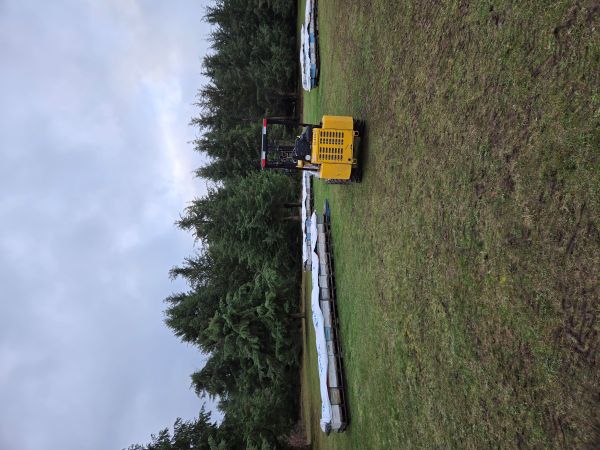
The hives covered with tarp at one of our Vancouver Island yards.
What's new on the farm:
Happy New Year!
We hope everyone had a wonderful holiday season and had time to enjoy good food with good company.
This year, our whole team took a break to enjoy some rest after a very busy season packing honey and orders.
It was the first year we had a team, and the first year we were able to take a true holiday break. We were so grateful for both!
Now everyone is back, rested, and ready for a new year.
Since our hives have all moved to Vancouver Island for the winter, many of you have wondered what happens to them while we are back in Saskatoon.
Do we check them? How do we know if they are okay? What do they do?
We do check on the yards to make sure everything is intact.
When we moved the hives to the island, we covered them with blankets and tarps to protect them from the rain and cold.
There can be some strong wind storms. While we are gone, the hives get checked by local friends and farmers to make sure everything stays in place.
As for the bees themselves, in the winter season, we make sure to leave them alone.
In the cold, the bees form a cluster to keep everyone warm. They vibrate their muscles to generate heat.
The queen bee stays in the center of the cluster, and the worker bees take turns going on the outside of the cluster.
Opening up the hives exposes them to cold air and light, which can break up the cluster.
If the cluster breaks, then the bees clump into smaller clusters and have a hard time going back to the big cluster.
These clusters may be too small to create enough heat to keep them alive, and they can get too cold and die.
We do everything we can in the late summer and fall to make sure the hives are healthy and strong.
After that, it does more harm than good for us to poke around in the hives when the weather is cold.
So in the winter, we don't interfere with the hives. We let them use their natural behaviors to survive.
We can't do much in the wintertime, but we still worry over them.
Andrew checks the weather obsessively in the summertime during the bee season. But in the off-season, he still worries about it.
Since the bees are on the island, their winter is much milder than if they were in Saskatoon. He is not concerned about it being too cold.
He does worry about it being too warm, though. Sometimes, you can get some nice days in the winter that are even warmer if the sun hits just right.
The problem for the bees is that if the weather gets warm enough, they will instinctively fly out of the hive and look for food.
But in the winter time, there just isn't much food around! The flowers are gone. There isn't any nectar or pollen available.
This is called "fruitless foraging" and wastes their energy as they seek out food, but come up short.
If they waste energy outside the hive, the less they have to keep warm and survive to keep the next generation going.
So, the temperatures need to be "just right" so that they are cool enough so that they don't fly out and waste energy. But also not so cold that the cluster can't keep warm.
In the prairies, some beekeepers actually keep winter sheds for their bees. They move all the hives into a temperature-controlled building.
The bees don't get too cold, and they don't get too warm. (Although you do have to worry about equipment failures to maintain the perfect temperature.)
Maybe one day we will have one ourselves. But we also love to bring the bees to the island because they can start their spring a few months earlier and forage for natural food sources.
Both the bees and the beekeepers get to enjoy the beautiful blooms that start up in March!
In the Kitchen
Since we aren't busy with the bees now, we have some time to work on new projects in the kitchen.
We are working on a new honey project, which we are very excited about.
Especially Andrew, since it includes one of his favorite ingredients.
If you want a hint...it's going to make your daily coffee taste incredible.
That's all I'm going to say for now!
Fruit and Nut Energy Balls
My mom has this recipe for energy balls sweetened with dates and honey that I love.
It's got lots of healthy fats and energy and it's literally just fruits, nuts, and honey.
When I want an "every day" sweet I just need one or two and I'm satisfied.
This is a loose recipe. You can substitute most of the ingredients with a similar nut or fruit that you have on hand or if you have a favorite.
Even the peanut butter can be swapped for almond, cashew, or sunflower butter, if that's your jam.
Ingredients:
- 1/4 cup white sesame seeds
- 1/4 cup black sesame seeds
- 1 cup almonds (finely chopped)
- 1 cup walnuts (finely chopped)
- 1/2 cup cashews (finely chopped)
- 1/4 cup raisins
- 12 dates
- 1/4 cup dried cranberries
- 4 tablespoons peanut butter
- 4 tablespoons honey
Directions:
- Mix all the nuts, seeds, raisins together in a bowl.
- Steam the dates and cranberries for about 10 mins to make them soft.
- Put the dates and cranberries into the blender and blend until smooth.
- Add peanut butter and honey to blender and blend until fully incorporated.
- Add blended mixture to the bowl of mixed nuts and stir so that everything is fully mixed.
- Form mixture into balls, or press into a flat sheet tray and cut into bars. If you cut into bars, store with parchment paper between layers.
- Store in an airtight container, put in the fridge, and chill for 1 day.