

· By Angela Seto
Bees sting...and bite?
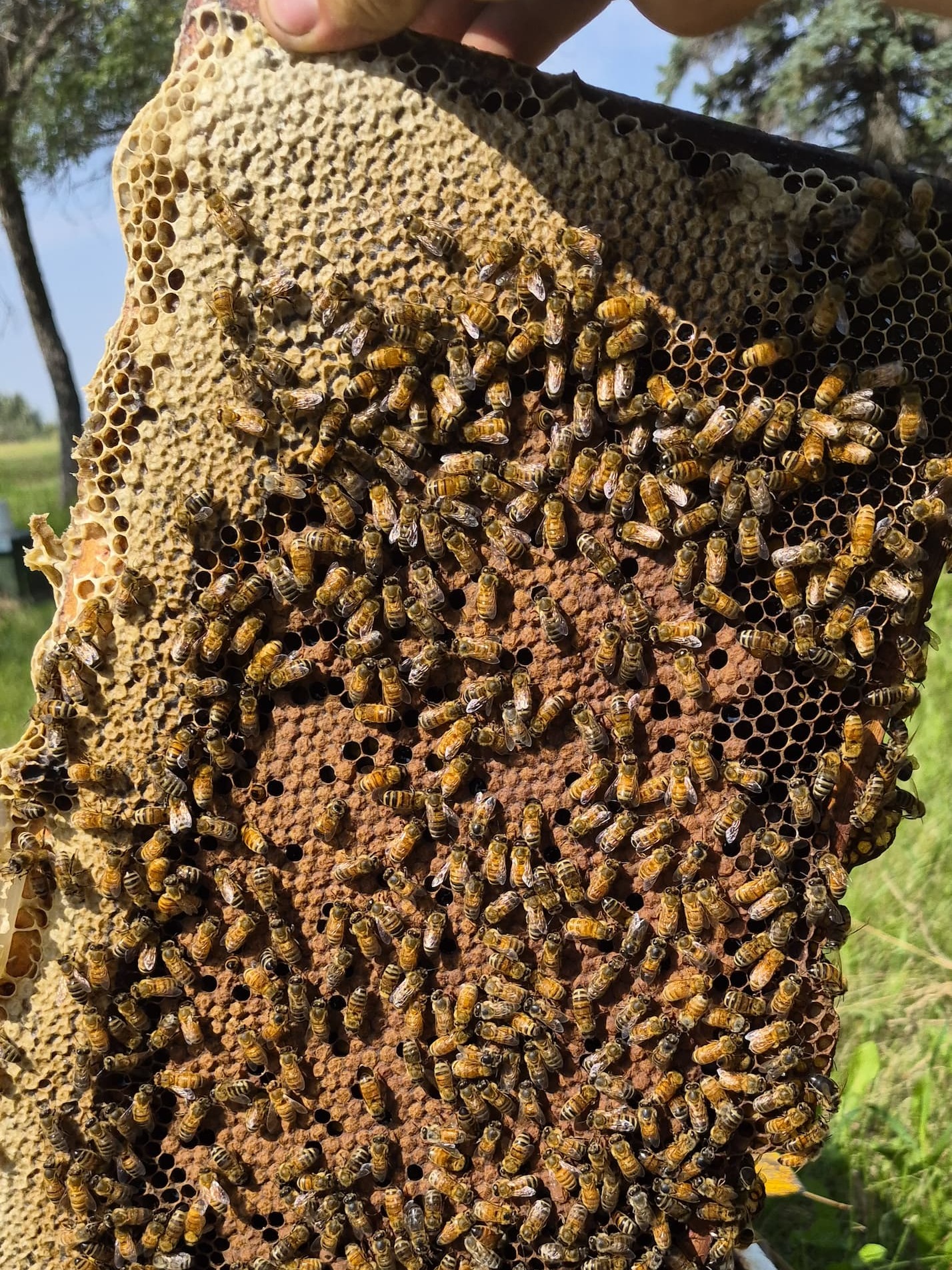
A well organized brood frame: honey stores are covered in light wax around the perimeter, brood (baby bees) are covered in dark wax in the middle of the frame. The brood wax is darker because the bees walk over it more often.
What's new on the farm:
Happy Labour Day Weekend!
Most years, on this weekend, we are wrapping up our harvest...but this year we still have honey boxes out on the yards.
But even though some hives still have honey boxes on them, for the rest of them, we are working on getting them ready for winter.
One of our top worries is always the Varroa mite. This mite can make a hive sick and weak very quickly if it gets out of hand. So we are always vigilant about how their populations are doing in the hive.
The bees can tolerate a small amount of mites, and there are specific behaviors that help manage the population. Mites like to latch onto the backs and wedge themselves into the abdominal plates of adult bees. They will suck on their blood and consume their fat bodies, making the bees weak.
To combat this, some colonies tend to be "natural groomers". These are bees that clean themselves and also help clean each other. The latter is especially important, because mites often feed in positions that a bee can't reach on their own.
A bee that has a mite latched on may do a dance which invites others to groom them. In response, other bees will come to their aid to knock off the mite that is harming them.
Another behaviour that bees use against mites is biting. Some colonies, while grooming, will just knock the mite off, but that mite can then just move on to another bee. Whereas other bees are more aggressive and will bite or crush the mites' legs, making them fall down to the bottom of the hive. With their legs damaged, they are unable to attach onto other bees or reproduce well.
Mites not only attack adult bees, but they love to feast on developing brood as well. Right before the bees cover the brood with wax so they can pupate and cocoon, a female mite will drop right in for a buffet.
As the bee continue to develop, the mite will feast and reproduce. The poor pupa is helpless as it cannot move, and it is trapped under the wax. Once it has fully developed into an adult bee and emerges out of the cell, all the baby mites will come crawling out right along it and disperse into the hive.
To address this, another important behaviour for combating mites is called hygienic behaviour. These bees are sensitive to the developing brood. They can detect that the brood smells "off" due to wounds and viruses inflicted onto the pupa.
Once this happens, they open up the wax cover, pull out the pupa, and then drag it out of the hive or eat it so it prevents the mite from reproducing further.
These are all special behaviours that help the bees withstand some mites, but sometimes the mites can start to overwhelm a hive. That's where we come in with extra help.
In the fall, you have to get the mites taken care of as early as possible, otherwise, the bees will be too weak to survive the winter.
The treatment changes based on the time of year. That's because you can't use most of them during the honey flow because you don't want to contaminate the honey.
After the honey boxes are off, we start using a special thymol-based treatment that is filled with essential oils like thymol, eucalyptus oil, camphor, and methol. When installed in the hive, the heat of the hive will cause the oils to release vapors. These vapors help knock mites off bees and increase grooming behaviours. The mite populations on the adult bees get reduced significantly, which is a huge win.
Now that the honey is almost done, we are working hard to make sure these bees get all the help they need to stay as healthy as possible to make it through winter!
Pumpkin Bread with Honey
'Tis the season for all things pumpkin and spice...this is a recipe for pumpkin bread that uses only honey to sweeten, which keeps it moist and rich. I go heavy on the spices because I am a big fan of all the cozy warming spices that fall brings.
If you want to be extra indulgent, slather on a scoop of our Chai Honey to amp up the fall flavors!
Check out the recipe at Cookie and Kate.