
· By Angela Seto
The most stressful drive of the year
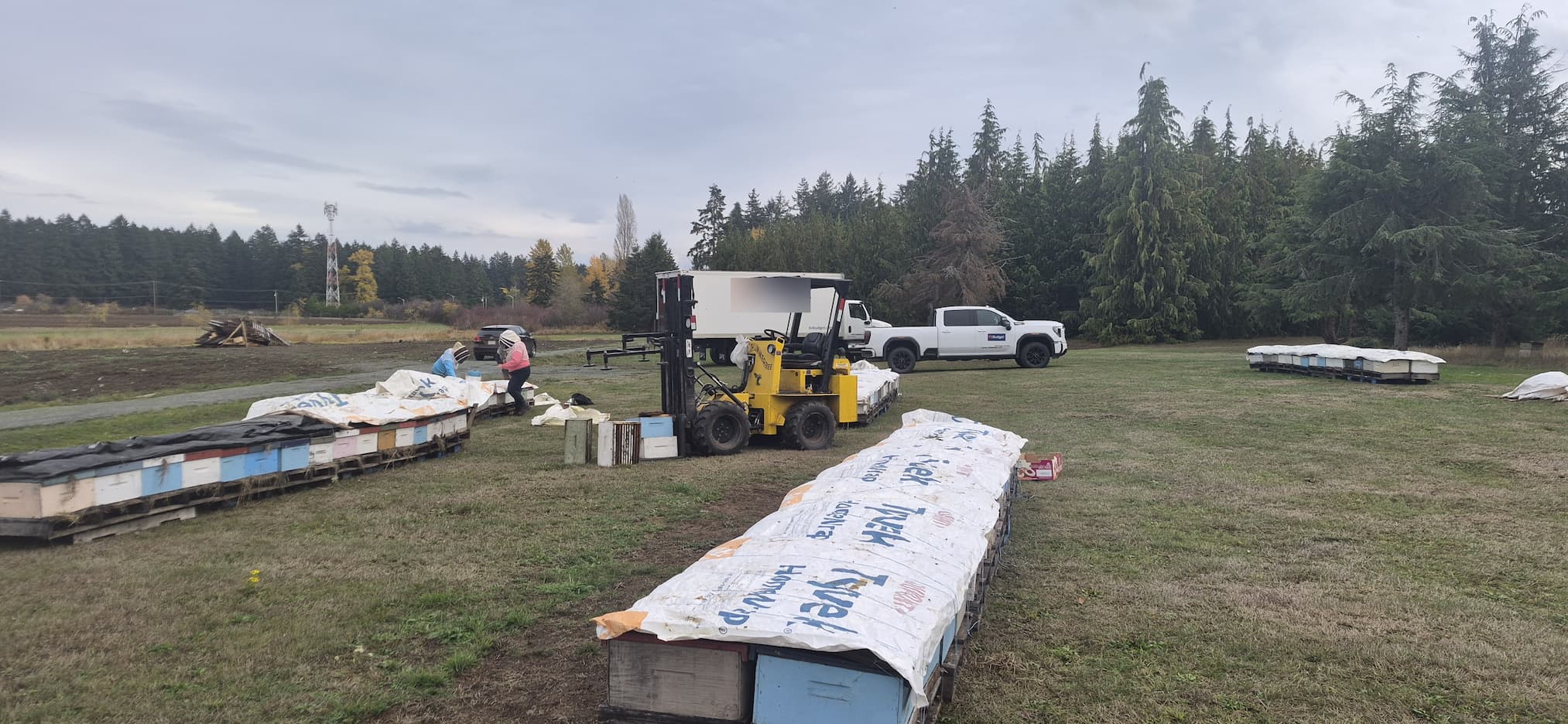
Covering rows of hives with bee blankets and tarp to keep the rain off at one of our Vancouver Island yards.
What's new on the farm:
Well, the bees have made it safely to Vancouver Island!
Often, people ask us, "how do you move your bees to Vancouver Island?"
When Andrew first started keeping bees on the island, he and a crew member would load a few hundred hives by hand onto the back of our box truck. It was hours and hours of work.
Then the drive would take two days. On the way, they would take breaks to open the back of the truck to cool off the bees. You see, all the hives in a confined space generate a lot of heat, so they had to take precautions so they wouldn't overheat.
The first night, they would stay in Canmore. If it snowed, they would shovel a bunch of snow into the back of the truck and leave the door open overnight to keep the bees cool.
On the second day, they would drive through the mountain passes. To get to Vancouver, they would make their way through the Coquihalla, which is considered one of the most dangerous mountain routes in Canada.
Unfortunately, our box truck always had issues, and this drive would really test it. Despite getting a tune up before the big trip each year, we would inevitably have some problems on the road. It would break down on the side of the road in the middle of Alberta. Flat tires on many occasions. Or the engine cooling fans would intermittently quit working while chugging up and down the mountain range.
Andrew would age a year each time he had to make that drive. The idea of sitting on the side of the road with a busted truck full of millions of bees was not a scenario he wanted to end up in.
On top of that, the weather was always a wild card! Floods, avalanches, windstorms. We've seen all of it. In 2021, we broke down outside Merritt, which is just after the Coquihalla highway. We called around desperately for a shop to take us.
"Can you fix our truck? Oh, and...it's full of bees."
We were so lucky that the weather was cool enough that the bees were cold enough that they would stay in their hives, so we found someone willing to take us into their shop under these conditions.
We had the truck towed to Vancouver. The next day, Merritt and the Fraser Valley flooded, and the highway closed due to mudslides and water. We were lucky to get out of there by the skin of our teeth, but had our bees gotten stuck there, we might have lost them all. Unfortunately, many people and businesses suffered from that flood that year. Late fall is no joke when it comes to traveling through the mountains in Canada.
Then, when the guys would arrive on the island, the work started. At the beginning, we didn't have the right equipment for migrating bees. Each hive had to be lifted by hand onto dollies, and wheeled on and off the truck. The work was back breaking, and it took a long time. It was Andrew's least favorite time of the whole year, but an important one for our season.
Over time, the process has gotten a bit less back-breaking. Now, all our hives live on special pallets that we can pick up with a forklift. The hives get loaded onto a flat-deck semi trailer and covered in nets, so we don't have to worry about them overheating. A professional truck driver, who specializes in bee transport, moves our hives. So we don't have to worry about equipment or driving. And when the bees arrive on the island, we have an all-terrain forklift that can load and unload them from our trucks.
But still! We worry, oh we worry. You can't help it when you're moving the value of your entire farm from one province to another. The process has gotten less laborious, because the scale is a bit bigger. But when you grow, your problems don't go away, they just change!
I don't want to jinx anything yet, but so far we have had a smooth time transitioning over to BC. The bees had an uneventful road trip over the mountains. All the equipment has been working. And we have lots of help on the island which makes the work go quickly. On Tuesday, the bees left Saskatoon. They were unloaded on the island on Thursday morning. The crew has been working hard to distribute all the hives to the outyards, and then wrapping them up with insulation and tarps to keep the hives warm and dry. A couple more days of work and that will be it for beekeeping for the 2026 season, and everyone will be able to come home!
Honey Cinnamon Roll-Ups
This is like the super-easy cousin to baklava, which is one of my favorite honey desserts. For me, baklava seems intimidating, like a treat that I think that I can only get at the restaurant, but this recipe is super approachable to make at home!
Check out the recipe at Taste of Home.