
· By Preston Peters
"Why don't you sell this at the grocery store?"
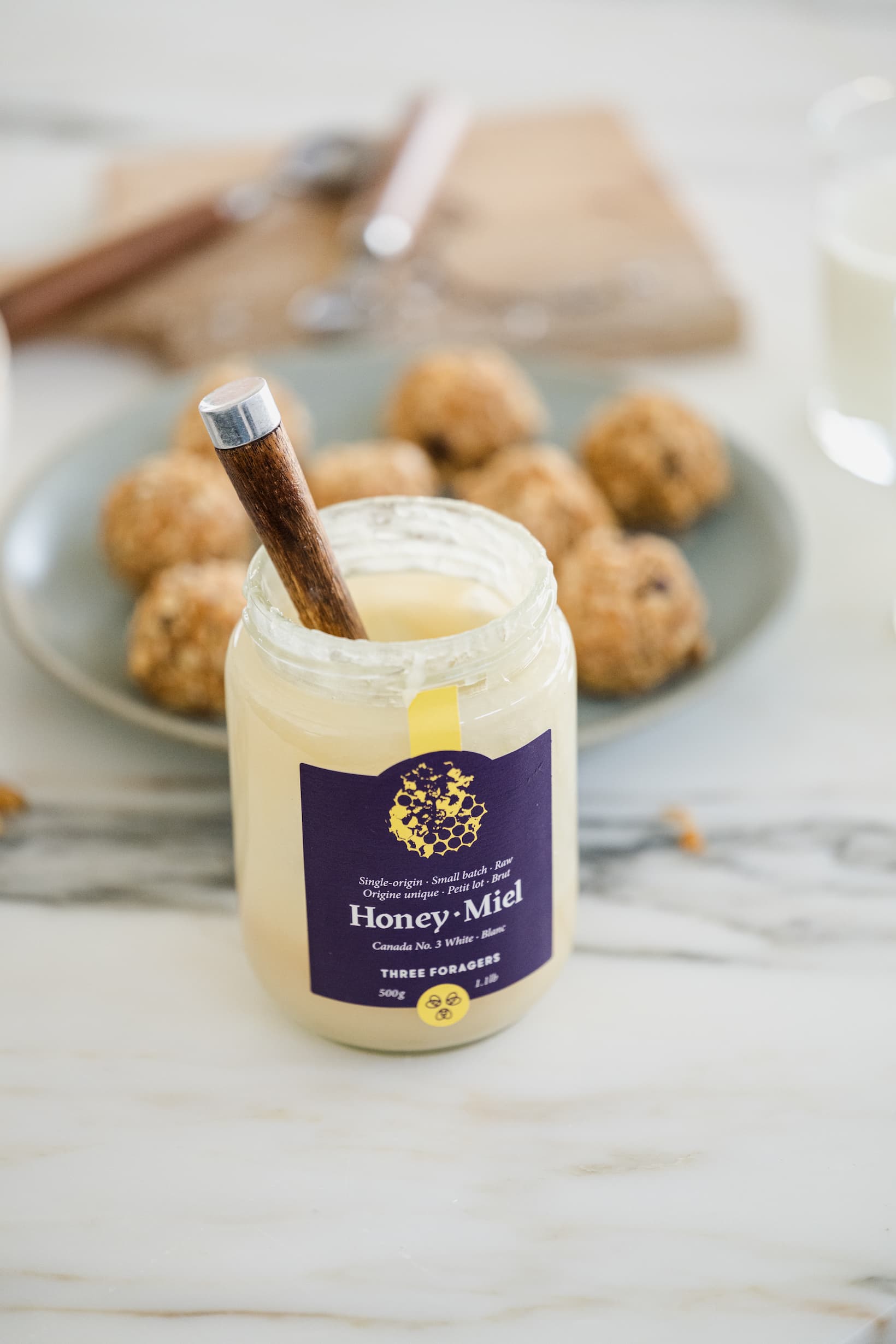
Making granola bites with our Creamed Honey
What's new on the farm:
I got a Facebook comment the other day that I've been thinking about. It was something like, "I don't understand why you don't sell this at the grocery store. Five jars is too much for me to try without tasting for the first time."
I get it. Our bundle is a commitment. It's a lot of honey to try for the first time (by the way, two-jar packs are available), and buying from a business you've only seen online is a leap of faith. But this question made me think about the gap of information that consumers now have about how food makes it from the farm to their door.
We used to be in the grocery stores in Canada. We were in over 200 stores, including some major chains. Firstly, being in the store isn't the producer's choice. For years, we went to trade shows and pitched our honey to grocery buyers. The grocery store decides who gets in, based on price, whether they think their customers want it, current trends, and other factors.
If you do make it onto the shelves, there is the reality of how much you actually make. When you sell to the grocery store, they take a cut of the price the customer pays. Then, to physically get to the store, a distributor takes a cut (or you factor in direct shipping costs) to move the product there. Then there's the marketing: advertising, coupons, the displays you see in the store. All that is paid by the producer. By the time everything is taken out, the amount that comes back to you is pretty small.
At the prices that work in a grocery store, you make very little per jar. To exist on that amount, you need to sell a lot of volume. To sell at high volume, generally you need to have lower prices. Our business uses slow, small-batch processes that aren't efficient for high volume. And the way we make our honey didn't line up with what's needed to be successful at the grocery store.
The inexpensive honey you usually see in grocery stores comes from big brands. It's often pasteurized, and almost always the same golden color. Pasteurization means heating the honey to a high temperature. In high-risk foods like dairy, that step is important for killing bacteria. But honey is naturally antibacterial because it is high in acid and low in water, which helps it resist bacterial growth without pasteurization.
So what's the point of pasteurizing honey? Large producers heat it because cold honey is thick and moves slowly. It's hard to push through pipes and filling machines when you're packing thousands of jars. Warming it up makes it thin and runny so it goes faster. The downside is the heat damages some of the enzymes and other unique compounds and flavor in the honey.
The uniform golden color comes from blending different honey varieties. Honey from one place looks different from the next. At the grocery store, you expect to buy the exact same product over and over again. So packers mix honey from different sources until they get the color customers expect.
The same pressures to sell uniform products at high volume and low prices show up with other foods in the grocery store. For example, brands that get into stores like Costco often adjust their product so the price works at that scale. That can mean using less expensive ingredients or broader sourcing. The Costco version of a product can be different than their product sold in other stores. A honey producer we know of got into Costco a few years ago. I thought, "Wow, they made it!" Then I found out that the Costco version of their honey is a blend of theirs and honey from another country.
It didn't work out for us at the grocery stores. We spent years working toward grocery store placement because that felt like the goal, the pinnacle of food brand success. But our business was suffering even though we knew our product was excellent. And we knew we couldn't compromise the way we made our honey, so we had to find another way.
The grocery store is truly an incredible food innovation that allows people to get affordable foods from all over the world in one place. People are busier than ever. We live in an era where not everyone has the time, energy, or money to spend sourcing all their food groups from specialized producers.
But being in the grocery store doesn't work for all businesses, like ours. It favors big corporations with low-cost products that give them room for big marketing budgets. And sometimes that means that the quality of what's on the shelf is not necessarily what someone wants. We are now happy to exist outside of that system, for the people who are looking for something more: a connection to the food they eat.
So, in a roundabout way, that's why we don't sell this honey at the grocery store!
No-Bake Honey Granola Bites
I sometimes fall prey to buying granola bars at the store for convenience, but they often have way too many ingredients that aren't there for flavor or nutrition.
These no-bake granola bites are fast and easy to make and can be easily transported for on-the-go snacks.
Once you get the hang of making these you can easily mix in your favorite seeds, nuts, or dried fruits so it's exactly the way you like it.
Check out the recipe from Tastes Better from Scratch.