
· By Angela Seto
What happens when sugar is cheap?
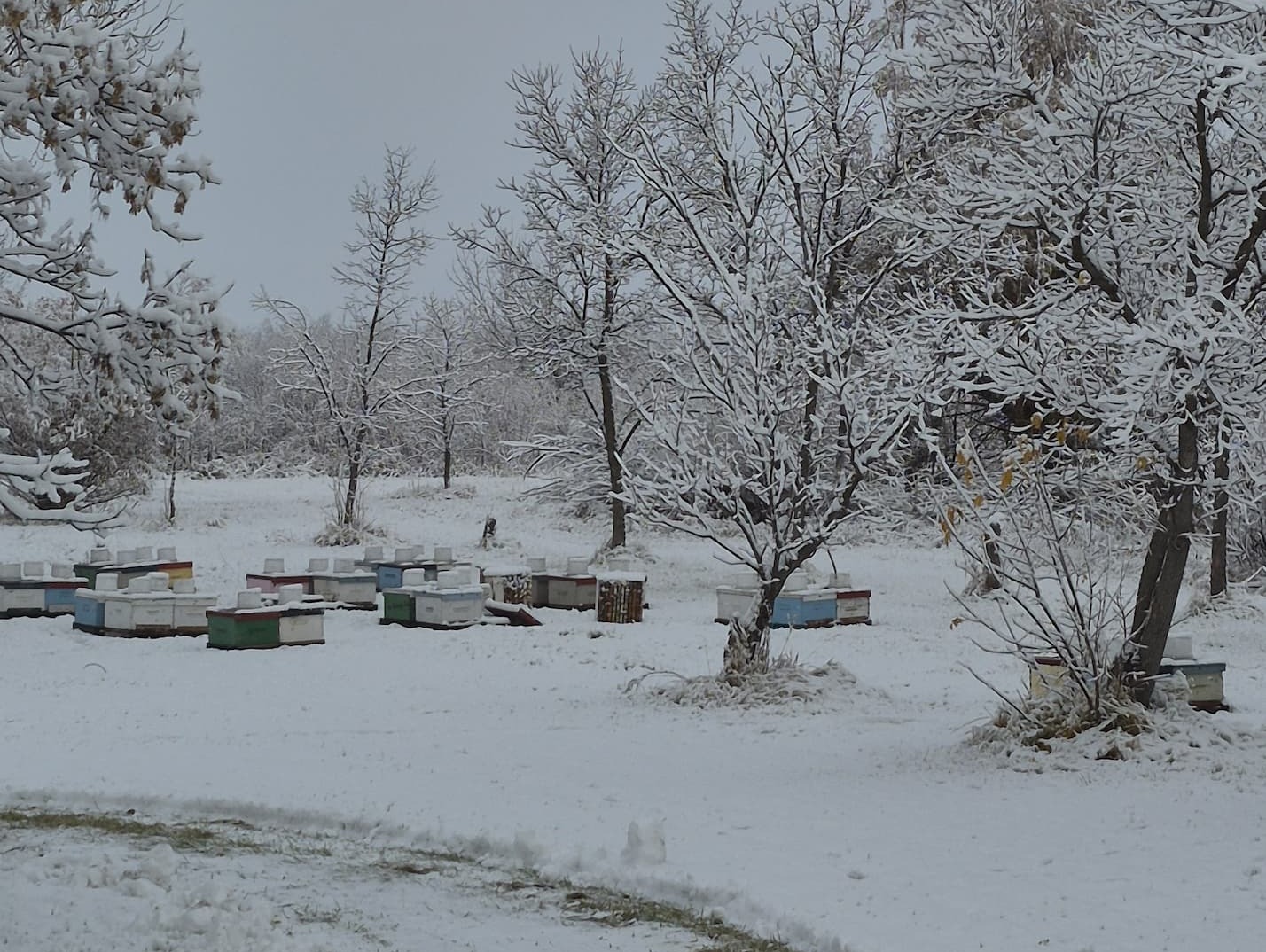
The first snowfall covering the hives on our home yard
What's new on the farm:
Happy November!
We are days away from leaving for Vancouver Island now.
The crew brought the hives back to the home yard. They've checked them all to make sure they are healthy and have enough food for the winter. Tomorrow, we will stack all the hives on top of each other so they are ready to load onto the semi-trailer that will take them out west.
Last week we had a surprise snowfall which is great for moisture but made it a bit harder to get work done. The poor crew had to slog out the last few days in the snow and cold.
It's all melted now, but now we need things to dry up over the next two days. When the semi arrives, the ground needs to be dry and hard enough for us to drive our forklift to load the semi.
Moving the bees is the most stressful part of the entire season. There are a lot of logistics involved, and everything is weather dependent too. Everything needs to work out just right!
But like everything we do related to Mother Nature, we will see how it plays out and figure it out as we go!
Why are we so sweet obsessed?
This might be a funny question coming from beekeepers, but hear me out.
I've been thinking about this a lot because beekeeping is one of the oldest jobs in the world, and honey is the oldest sweetener in the world. Humans have had access to honey for somewhere between 8000 to 10000 years.
Over time, we figured out how to get sugar from sugarcane, but it was still expensive for most people for a long time. In the 19th century came the sugar beets, which made sugar production more abundant because it didn't rely on sourcing sugar cane in the tropics. Pair that with the industrial revolution, and refined sugar became very cheap and very abundant.
It became so cheap that people stopped buying honey. Before industrialized sugar production, sugar was 20-30 times more expensive than honey. It was reserved for the wealthy, or for medicines. Honey was the everyday sweetener for most people. But once we were able to produce sugar on an industrial scale, the prices plummeted. Honey production would never be able to catch up, because you can't scale bees the same way you can build factories, and strip out massive plots of land to plant sugarcane and sugar beets.
Now, sugar is too cheap, at our own peril. Once sugar became cheap, our consumption skyrocketed. We went from eating 8-10 lbs/year pre-industrialization to 35-40 lbs/year in 1870, 70-80 lbs/year in 1910, to a peak of 150 lbs/year in the 1990s.
Over this period, the North American food industry pumped sugar and high fructose corn syrup in so many foods, even those that didn't need sugar. We had processed sugars marketed to us like crazy, our lives got busier, and we traded home-made treats and food for store-bought versions. Our palettes became trained to desire more and more sugar. It activated our happy pleasure receptors in our brain, which meant we would crave more, and buy more food.
Unfortunately, our health as a society has really suffered as a result. And the part that really bothers me is that other regions aren't like ours. When these huge food corporations start to expand to markets outside of North American, they sell less sweet versions of the same brands.
And I'm not talking about a version that has a sugar alternative to keep the same sweetness with less calories. They just make the food with less sugar in the recipe, because that market doesn't like foods to be as sweet as we do. Other markets simply never went through that same century of cheap, abundant sugar being pushed into everything. Their baseline expectation for sweetness stayed lower. Ours didn't.
I believe that people are starting to realize this. From the 1990s, our annual sugar consumption started to go back down, to about 120 lbs/year in 2024. But the food industry is wise to this. Now the grocery store is piled with products sweetened with sugar alcohols and stevia. Same sweetness, less calories. Is this a better solution? It's certainly a way that they can keep selling processed foods to us. But I don't really think they have our best interests at heart. What do you think?
Honeyed Winter Salad
This is a cozy salad that combines roasted winter vegetables with the freshness of spinach or you can use any leafy lettuce you prefer.
It's a nice way to lighten up the usual roasted vegetables when you want some variety for dinner!
Check out the recipe at BBC Good Food.