
· By Angela Seto
Do the bees stay wrapped all winter?
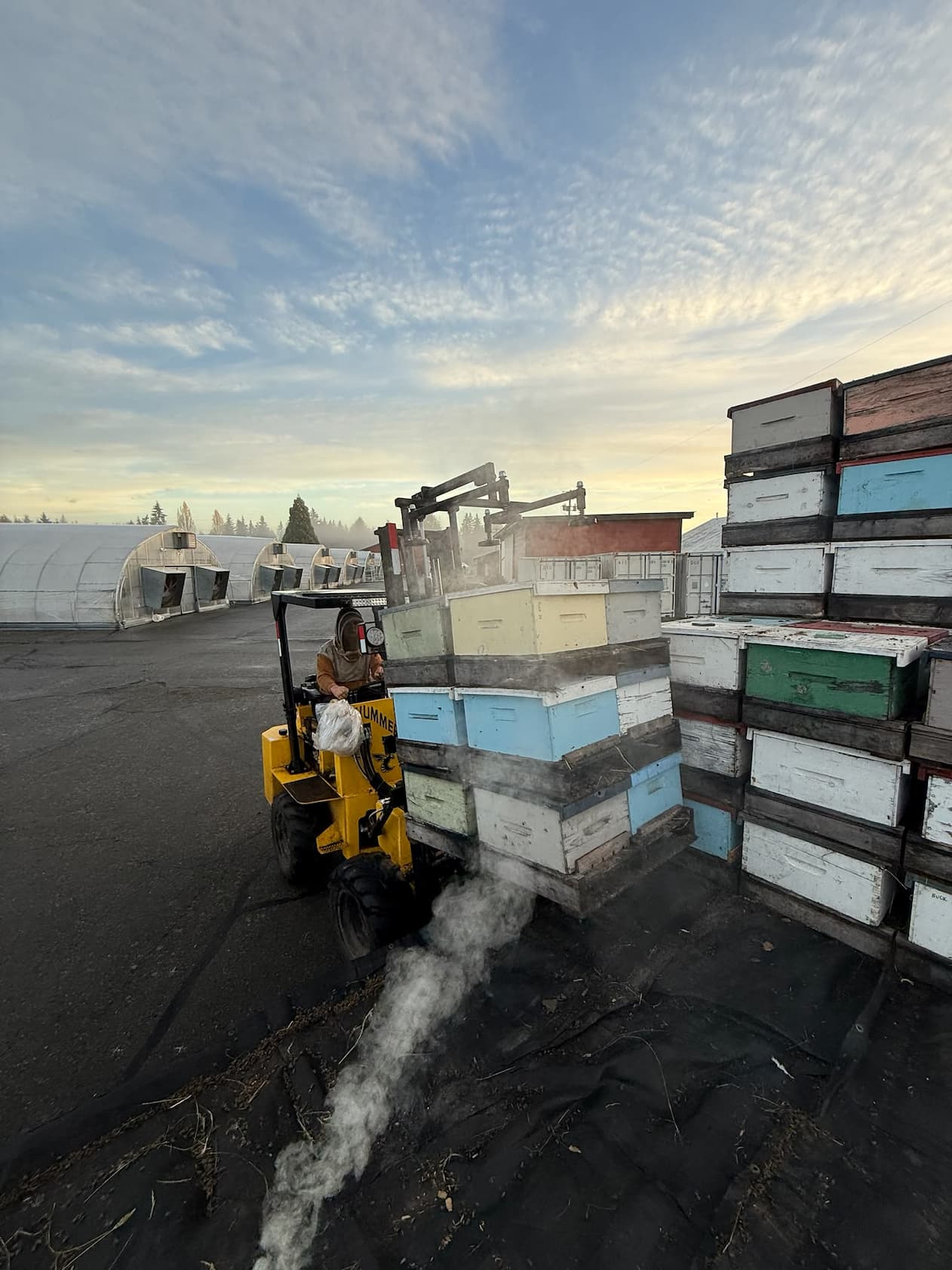
Andrew unloading a stack of hives off the semi-trailer in BC.
What's new on the farm:
That's a wrap for our bees in 2026. All our bees are now tucked in nice and cozy for the winter on the West Coast.
Unlike past years, this time was drama-free. That doesn't make for great newsletter material, but it's much better for our nervous systems. We had tons of help from family and family friends this year. The bees arrived with no issues on the road or the ferry, and all the equipment worked.
All the bees were first unloaded off the semi-trailer, and then loaded in batches onto a smaller box truck. The crew drove the box truck to different outyards hosting our bees. At each site, they would set up pallets in rows, and then unload the bees onto the pallets so that they were off the ground.
Then each row was covered with a few insulating blankets on top, followed by a sheet of tarp tied over everything to keep the rain off all winter. It's simple but hard and laborious, so having many hands this year made it go by quickly!
Now that we are finished working with the bees, all our focus can go back to the kitchens. I'm excited to say that we are going to be launching two new products just before the holidays in the next week-ish. Stay tuned!
For now, we have had some reader questions come in that I wanted to answer this week:
From Glenn: Do the bees stay wrapped all winter? What do they do all winter?
Yes, the hives stay wrapped up! The entrances are still open so the bees can freely fly in and out of the hive if they want to, especially on a nice warm day. For the most part, the bees eat honey and cluster together around the queen to stay warm. Since it's cold out and there are no flowers to gather nectar or pollen from, there isn't much for them to do outside. In late winter, the queen will begin laying eggs again to start the next generation of bees, so the winter bees will also begin taking care of the brood nest.
Fun fact: bees are very sanitary and do not void themselves inside their hives. So they will hold it all winter long until there is a nice warm day for them to leave the hive and do a "cleansing" flight. In the early spring, if you are working around the hives on a warm-ish day, your bee suit usually ends up covered in a lot of bee poop.
From Les: If you don't send the bees to Vancouver [Island], can they stay alive over the winter?
Yes, most Saskatchewan beekeepers do not move their hives! You may be surprised to learn that honeybees can withstand the brutally cold temperatures. Many beekeepers winter their hives outdoors in the Saskatchewan winters. Groups of four hives get pushed together, so they can share their heat, and they get wrapped in thick insulating blankets on top and around the hives.
Others will move the bees into wintering sheds that are climate-controlled. The clustering honeybees give off a lot of heat, so the sheds need to be well ventilated so the bees don't get too warm. If the bees are too warm, they will be more active than they should be in the middle of winter.
For decades we wintered all our bees outdoors in Saskatchewan. In recent years we have moved all our hives to the island, but this year we are wintering a small portion of hives in Saskatoon.
The reason why we go to Vancouver Island is that spring starts a month earlier. That means we can start working with the hives, and they will start growing earlier in the season. That gives us opportunities to split up the hives to increase our numbers, or simply have bigger hives going into honey production season.
From Dona: How do you cream your honey (which is delicious)? Is there an additive?
"Creaming" honey is a slightly confusing term because we definitely don't add any cream to it! It's the process of controlling the crystallization of the natural sugar molecules in the honey. Our honey comes from floral nectars that naturally crystallize quickly, within 3-4 weeks of harvest. This is unique, as most other honey varieties take much longer to crystallize. When our honey naturally crystallizes, the sugar molecules form larger crystals, which result in a hard, thick honey. Some years, it can be so hard it will bend your spoon!
To make it easier to use without altering the nutrients, we stir the honey as it's crystallizing. By stirring it, you don't let the natural sugar molecules grow to a larger crystal size because the agitation keeps breaking it down. Eventually, the molecules all form smaller crystals, which result in a creamier, smoother honey that is easier to scoop. The key thing is that nothing is added, and nothing is removed. It's still just 100% unpasteurized honey!
That's all for today's letter. If you ever have questions about our beekeeping or processes, please send them in! We read every email and do our best to reply to every question!
Hot Honey Cranberry Camembert
The holiday season is my favorite time to indulge in warm, comforting foods I normally wouldn't eat year-round.
By the time November rolls around, melty cheese balanced with tart cranberries and hot honey is high on my list of cravings.
If you don't already have a jar of our Spicy Honey (no longer available 😞), you can make your own with this recipe, or just skip the heat and add pure honey!
This is a great holiday appetizer recipe that you can serve with crusty breads or crackers, and it is sure to be a hit!
Check out the recipe at How Sweet Eats.