
· By Angela Seto
Runny or creamy?
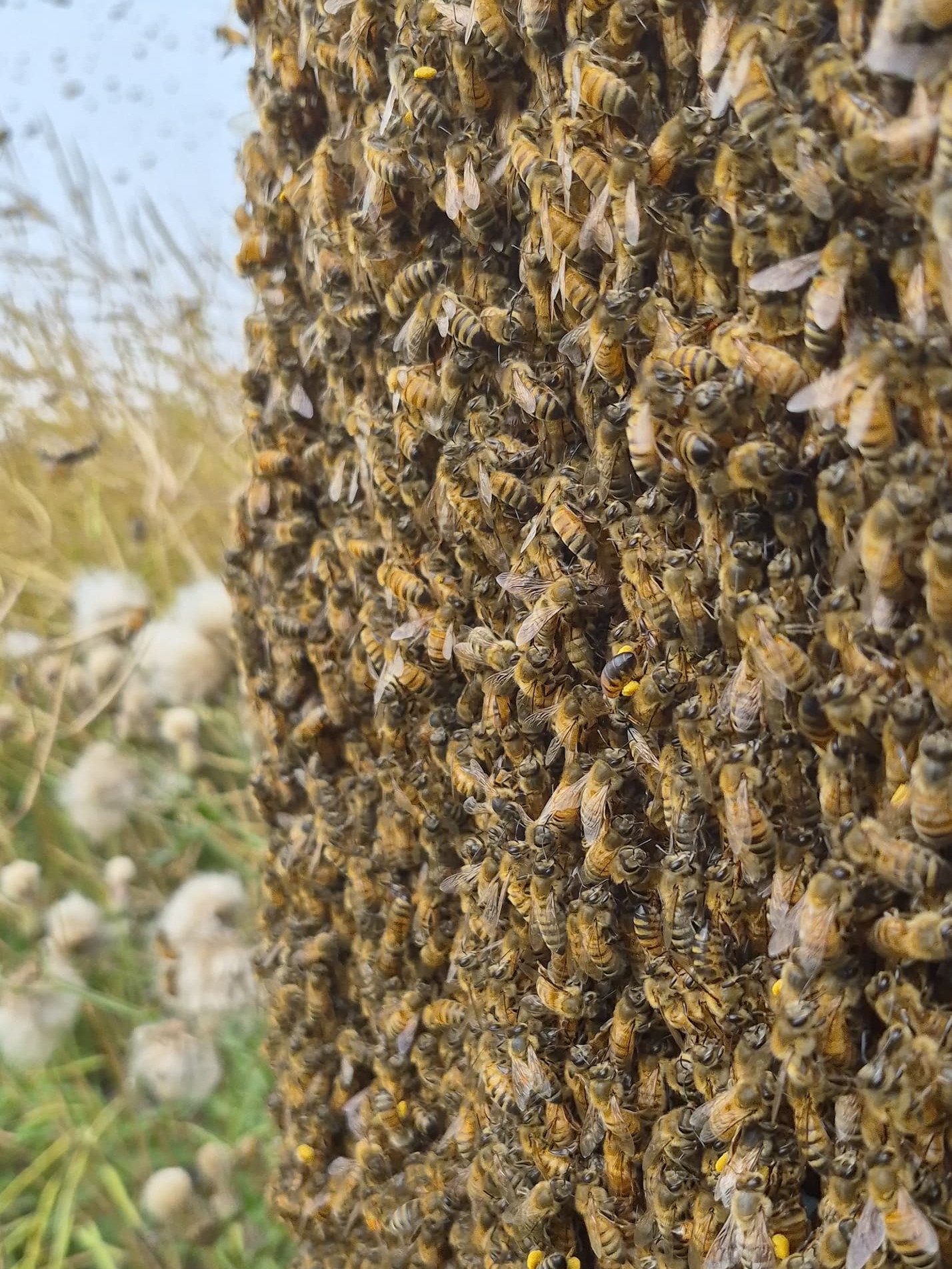
Close up of a "beard" of bees hanging outside a hive.
What's new on the farm:
We have reached the end of August and even though harvest is winding down, there is no shortage of things to do.
The farm is getting busy getting ready for winter preparations, but the transition hasn't fully happened yet. Since we aren't doing too much new stuff yet, I wanted to poke my head into readers' questions again this edition.
From Eva T.: I am a new customer and have a question: how long will your honey keep in my cupboard?
Since our honey is unpasteurized, people often have this question. However, unlike other foods like dairy, and juice, honey doesn't need to be pasteurized to be safe to eat or have a long shelf life. The reason that honey is pasteurized is to delay crysallization.
As long as honey is stored in a cool, dark, and dry place (like a pantry or cupboard) it will last a super long time! It's naturally antibacterial, antimicrobial, and antifungal, so it's very resilient and keeps its quality for a very long time.
We have to put a best-before date on the package for food regulations, so we put a best-before of five years from the time that the honey is packed. That said, with proper storage, honey will last pretty well forever!
From Mike M.: I recently received some local honey that says raw from the hive but it is very runny, where as your honey is more creamy. Would that indicate the the runny honey was indeed processed and cut with something??? Or is it possible the runny honey also came straight raw from the hive. Thank you.
We have had this question come up a few times now, and I am happy to clarify. Raw and unpasteurized honey can be runny, and it can also be solid and crystallized. Honey can be in many different forms!
The reason it is different is that the texture, colour, and taste are determined by the floral nectar source. Every part of the world has different flowers, or combinations of flowers. The honey that comes from different parts of the world will be different as a result!
Unfortunately, most people see honey as the same golden, runny liquid. How is that, if there are so many flowers all over the world? Shouldn't the honey look different?
That's where things can be more complicated when you are trying to decide if the honey you see in front of you is legitimate or not. Because once the honey is harvested, processors can also affect the texture, colour, and taste by how they process the honey.
In the grocery world and most of the food industry, uniformity and shelf life is king. When you are a big business supplying food to the masses, your product has to be the same every time.
This effect has a double-edged sword. People buy something from the store, and they expect it to be the same the next time they buy it. This can be possible with most processed foods. It also affects perishable foods. Think of all the perfect-looking tomatoes and cucumbers you see in the grocery store. All the same shades and shapes. You can buy them in September or April, and they will be the same.
But...food isn't really like that. If you grow your own vegetables or fruit, this is very obvious. To get that uniformity, tons of produce is wasted and tossed because it doesn't look right. And over time, people only see one version of a food their whole lives, and they can't believe that it should look any other way.
With honey, most people might only know the golden liquid type their whole lives. That's because most big processors try to make the same honey every time. They blend honey with different colours to get the perfect medium. Then they pasteurize it so that it stays liquid and runny for a long time on the shelf. The result is perfectly golden and liquid.
But honey is actually very diverse. There is an entire colour grading scale that beekeepers use to grade their honey! It goes from "water-white" to "dark amber", which almost looks black.
Different flowers make honey that crystallizes at different rates. Tupelo honey is famous for almost never crystallizing and staying liquid forever. It's usually only made in Florida and Georgia. Buckwheat honey is famous for being dark and bitter. It's commonly harvested in Manitoba. Our Saskatchewan prairie honey is a multifloral honey, foraged from alfalfa, sweet clover, wildflowers, and canola, and is a water-white honey that is mildly floral and crystallizes within 3-4 weeks of harvest.
So how do you know if you are getting unprocessed, high-quality honey? Well, the best thing is to know who you're buying it from. That way, you can ask them questions. "How was this made? Which flowers did you harvest from? Why is it creamy? Or liquid?" Exactly what Mike is doing here.
Roasted Honey Glazed Carrots
I will never not love roasted vegetables coated in a delicious sweet glaze. This recipe is such a warming dish that makes use of fresh carrots that are in season. This would be a great use of your garden carrots or a bunch you can find at the farmers' market!
Check out the recipe at Downshiftology.